What is a DUT?
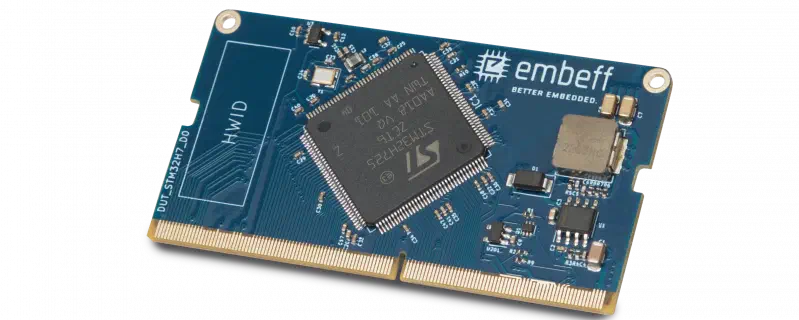
The Device Under Test is a small PCB that carries your microcontroller and its basic circuitry, such as the oscillator.
It plugs into the generic ExecutionPlatform and routes all relevant microcontroller pins to the test system.
You change it yourself: power down the ExecutionPlatform, open its case and swap the PCB. Everything reconfigures automatically.
Match your project exactly
Every project needs a DUT for its own chip.
The surrounding circuitry, such as the oscillator frequency, matches your project too.
That is why we do not sell ready-to-use DUTs, although we have samples for a range of microcontroller families.
Example: our RP2040 DUT carries the chip with its 12 MHz crystal and routes every free pin to the test system.
RP2040 DUT schematic (PDF)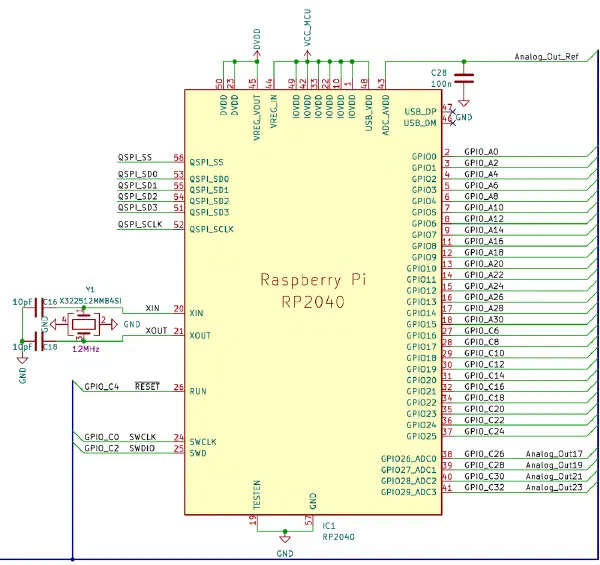
Check your microcontroller
A SEGGER Flasher inside the ExecutionPlatform programs your firmware. Your chip must be supported by SEGGER Flasher Compact; unsupported chips can be added on request.
Up to 144 digital pins at voltage levels of 1.8 V to 3.3 V.
Up to 24 DUT analog inputs and 8 DUT analog outputs, with signal levels between 0 V and 5.0 V.
Not limited to microcontrollers: FPGAs, SOMs or even ASICs can be placed on a DUT. Contact us with your request.

Two ways to your DUT
We build it for you
Fill in the DUT questionnaire and send it to us. We design the DUT for your project and deliver working sample code (BSP) and examples for your chip. Most customers start this way. See prices for the one-time cost.
Download the questionnaireBuild it yourself
Create the DUT in-house, based on our free DUT integration template. Ask us for the template and we send it to you.
Request the template